Thursday, June 10, 2010


Friday, March 5, 2010
Car body style


Sedan
A sedan car (American English, pronunciation /sɪˈdæn/) or saloon car (British English) is a passenger car with two rows of seats and adequate passenger space in the rear compartment for adult passengers. The vehicle usually has a separate rear trunk (boot in British English) for luggage, although some manufacturers such as Chevrolet, Tatra, and Volkswagen have made rear-engined models. It is one of the most common body styles for modern automobiles.Hardtop
A hardtop is a term for a rigid, rather than canvas, automobile roof. It has been used in several contexts: detachable hardtops, retractable hardtop roofs, and the so-called pillarless hardtop body style.


Coupé
A coupé or coupe (from the French verb couper, to cut) is a closed car body style, the precise definition of which varies from manufacturer to manufacturer, and over time. Coupés are often hardtopped sports cars or sporty variants of sedan (saloon) body styles, with doors commonly reduced from 4 to 2, and a close-coupled interior (i.e., the rear seat placed further forward than in a standard sedan) offering either two seats or 2+2 seating (space for two passengers in the front and two occasional passengers or children in the rear). Before the days of motorized vehicles, the word referred to the front or after compartment of a Continental stagecoach.
Club coupé

Business coupé

Opéra coupé

Sports coupé or berlinetta

Four-door coupé

Quad coupé

Combi coupé

more to list...keep checking...
Tuesday, March 2, 2010
Hand brake - Will it always help?
Anyone wondered what the hand brakes do? What happens when someone drives the car with the hand brake used?
 Hand brake or parking brake usually clubs with the usual brake system of the vehicle, exception is the electronic hand brake system.
Hand brakes are acting on the rear wheels immaterial of what drive the car is, say front wheel, rear wheel or 4X4 drive.
Actually the hand brakes are less effective than the usual braking system. Hand brake is connencted to the usual braking system through another cable/hydraulic system, which serves the advantage of operating it independent, also to keep in the position.
In cars, the hand brake (also known as the emergency brake, e-brake, or parking brake) is a latching brake usually used to keep the car stationary. Automobile e-brakes usually consist of a cable (usually adjustable for length) directly connected to the brake mechanism on one end and to some type of lever that can be actuated by the driver on the other end. The lever is traditionally and more commonly a hand-operated system (hence the hand brake name), the most common configuration being a handle on the floor between the driver and front passenger, and less commonly being a handle bar located on the lower portion of the dashboard somewhere close to the steering wheel column or between the driver and their door. Alternatively, the lever can be on the floor between the driver and the door or foot-operated, in the form of a pedal in the foot well in front of the driver, located to the far left apart from the other pedals.
Cars with rear disc brakes have a more complicated emergency brake system, sometimes requiring an entire drum brake system to be mounted inside of the rear rotor, called an exclusive parking brake or auxiliary drum brake [source: Owen].
When to Use the Emergency Brake
Using the emergency brake to stop a moving vehicle outside of a total brake failure is not recommended and can damage your brake system. This is why it's not a good idea to pretend you're a racecar driver and slam on the e-brake to spin in a circle. Driving with your emergency brake engaged can also cause damage to the emergency brake cable and the service brakes. If this happens to you, have your brake shoes and rotors checked as soon as possible, to ensure everything is OK.
The most common use of the emergency brake is as a parking brake. Those who drive manual transmission vehicles, or stick shifts, usually engage the emergency brake every time they exit the car. If not engaged, the car might just roll away all on its own. Automatic transmission drivers tend to use the emergency brake far less, if at all.
It's recommended that you engage the emergency brake anytime the vehicle is parked on a hill, whether it's an automatic or standard transmission. For an automatic, setting the emergency brake before you release the service brake pedal will keep weight off the transmission, making it easier to shift out of park [source: Rubenstein].
http://auto.howstuffworks.com/auto-parts/brakes/brake-types/emergency-brakes.htm

Hand brakes are acting on the rear wheels immaterial of what drive the car is, say front wheel, rear wheel or 4X4 drive.
Actually the hand brakes are less effective than the usual braking system. Hand brake is connencted to the usual braking system through another cable/hydraulic system, which serves the advantage of operating it independent, also to keep in the position.
In cars, the hand brake (also known as the emergency brake, e-brake, or parking brake) is a latching brake usually used to keep the car stationary. Automobile e-brakes usually consist of a cable (usually adjustable for length) directly connected to the brake mechanism on one end and to some type of lever that can be actuated by the driver on the other end. The lever is traditionally and more commonly a hand-operated system (hence the hand brake name), the most common configuration being a handle on the floor between the driver and front passenger, and less commonly being a handle bar located on the lower portion of the dashboard somewhere close to the steering wheel column or between the driver and their door. Alternatively, the lever can be on the floor between the driver and the door or foot-operated, in the form of a pedal in the foot well in front of the driver, located to the far left apart from the other pedals.
Cars with rear disc brakes have a more complicated emergency brake system, sometimes requiring an entire drum brake system to be mounted inside of the rear rotor, called an exclusive parking brake or auxiliary drum brake [source: Owen].
When to Use the Emergency Brake
Using the emergency brake to stop a moving vehicle outside of a total brake failure is not recommended and can damage your brake system. This is why it's not a good idea to pretend you're a racecar driver and slam on the e-brake to spin in a circle. Driving with your emergency brake engaged can also cause damage to the emergency brake cable and the service brakes. If this happens to you, have your brake shoes and rotors checked as soon as possible, to ensure everything is OK.
The most common use of the emergency brake is as a parking brake. Those who drive manual transmission vehicles, or stick shifts, usually engage the emergency brake every time they exit the car. If not engaged, the car might just roll away all on its own. Automatic transmission drivers tend to use the emergency brake far less, if at all.
It's recommended that you engage the emergency brake anytime the vehicle is parked on a hill, whether it's an automatic or standard transmission. For an automatic, setting the emergency brake before you release the service brake pedal will keep weight off the transmission, making it easier to shift out of park [source: Rubenstein].
http://auto.howstuffworks.com/auto-parts/brakes/brake-types/emergency-brakes.htm
Wednesday, February 24, 2010
intelligent-VTEC - The Next Generation
VTEC (Variable Valve Timing and Lift Electronic Control)

The last evolution of Honda's VTEC system was back in 1995 where they introduced the now-famous 3-stage VTEC system. The 3-stage VTEC was then designed for an optimum balance of super fuel economy and high power with driveability. For the next 5 years, Honda still used the regular DOHC VTEC system for their top power models, from the B16B right up to the F20C in the S2000. Now Honda have announced the next evolution of their legendary VTEC system, the i-VTEC.
The i stands for intelligent : i-VTEC is intelligent-VTEC. Honda introduced many new innovations in i-VTEC, but the most significant one is the addition of a variable valve opening overlap mechanism to the VTEC system. Named VTC for Variable Timing Control, the current (initial) implementation is on the intake camshaft and allows the valve opening overlap between the intake and exhaust valves to be continously varied during engine operation. This allows for a further refinement to the power delivery characteristics of VTEC, permitting fine-tuning of the mid-band power delivery of the engine.
Variable Timing Control Operating Principle
Honda's VTC operating principle is basically that of the generic variable valve timing implementation (this generic implementation is also used by by Toyota in their VVT-i and BMW in their VANOS/double-VANOS system). The generic variable valve timing implementation makes use of a mechanism attached between the cam sprocket and the camshaft. This mechanism has a helical gear link to the sprocket and can be moved relative the sprocket via hydraulic means. When moved, the helical gearing effectively rotates the gear in relation to the sprocket and thus the camshaft as well.
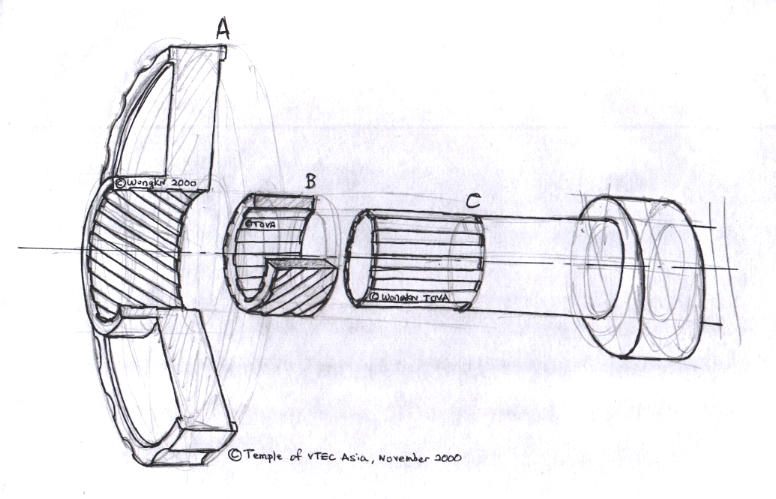
The drawing above serves to illustrate the basic operating principle of VTC (and generic variable valve timing). A labels the cam sprocket (or cam gear) which the timing belt drives. Normally the camshaft is bolted directly to the sprocket. However in VTC, an intermediate gear is used to connect the sprocket to the camshaft. This gear, labelled B has helical gears on its outside. As shown in the drawing, this gear links to the main sprocket which has matching helical gears on the inside. The camshaft, labelled C attaches to the intermediate gear.
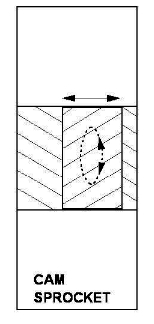
The supplementary diagram on the right shows what happens when we move the intermediate gear along its holder in the cam sprocket. Because of the interlinking helical gears, the intermediate gear will rotate along its axis if moved. Now, since the camshaft is attached to this gear, the camshaft will rotate on its axis too. What we have acheived now is that we have move the relative alignment between the camshaft and the driving cam-sprocket - we have changed the cam timing !
VTC and other implementations of generic variable valve timing can only change the relative alignment between the camshaft and its driving sprocket. What this effectively does is to change the relative timing between the intake and exhaust cams and thus their valve opening cycles or the intake and exhaust valve opening overlaps. Note that no other valve timing parameters, eg amount of valve lift or absolute valve opening duration can be varied. The only thing that VTC varies is the valve opening overlaps. VTEC is able to vary all valve timing parameters but current implementations does so in two or three distinct stages (or profiles). Adding VTC allows the valve opening overlaps to be continously varied and thus enables the power delivery from the standard VTEC system to be further fine-tuned. The greatest impact will be to the mid-band power delivery of the engine. Most importantly, VTC (and generic valve timing systems) will not replace VTEC but enhance its effectiveness.
The current state of i-VTEC
At the moment, i-VTEC is only implemented in the relatively low specific power output engine of the new JDM Honda STREAM van. Used in the 2.0l DOHC i-VTEC engine, it allows Honda to boost low-end and mid-range power of that engine, a characteristic very desirable for that model. In my opinion, VTC is the most significant innovation that Honda introduced to i-VTEC. Other important innovations includes the changing of the engine orientation (as well as its rotation direction). i-VTEC engines are mounted such that the intake valves faces the front of the vehicle and the exhaust valves the rear, just like the Japanese Grand-Touring Championship racing cars. Other improvements are in the important areas of fuel economy and emissions.
Honda announced i-VTEC via a special article in the tech section of their official web-site. As usual, TOVA's japanese article specialist Kaz Mori has translated that article which we reproduce in its entirety in the box below.
Ref:
HowStuffWorks "How Clutches Work"
HowStuffWorks "How Clutches Work"
"Howstuffworks.com" -- this is the site I rely for most of my doubts regarding technical aspects, here is the description of Working of Clutches, if u want to get an idea about clutches, I will recommend this first, take a look.
Exploring the Machines
Am here to share what all things I know, I hope it'll be useful for someone out there... Am not explaining much, coz, there are other good things to say..!
Subscribe to:
Posts (Atom)